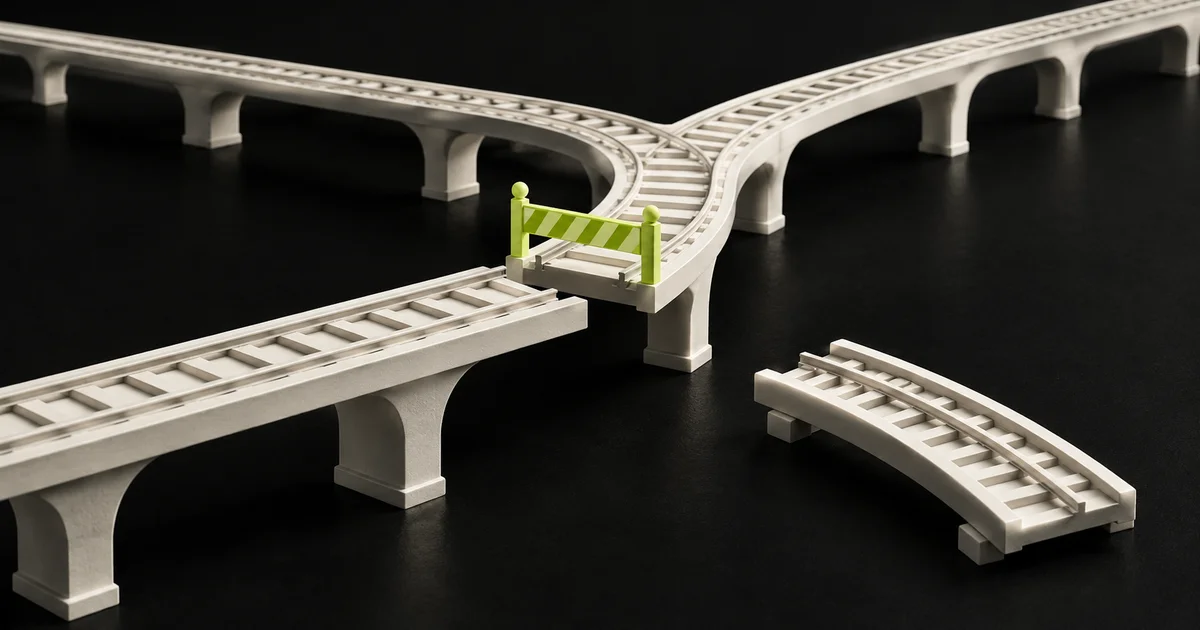
Crypto delisting risk for trading bots arises when a venue removes a pair, token or contract that the automation still expects to trade. Stop new commitments before the applicable deadline, reconcile orders and actual exposure, and follow the specific venue notice for remaining assets or settlement. A stopped bot, canceled order or missing symbol does not prove that the account is flat.
First identify what is being removed
A delisting notice can describe different events: removal of one spot pair, removal of an asset's spot markets, or termination of a derivatives contract. These have different consequences for inventory, withdrawals and position settlement. Record the exchange entity, account, product and exact symbol before deciding which bots are affected.
For example, Binance's July 2026 notice removed selected spot pairs while stating that their base and quote assets could still trade through other available pairs. It also terminated applicable Binance Spot Trading Bots services for those pairs. That notice concerns Binance's services; it does not establish how an external bot behaves. See the Binance spot-pair removal notice.
A pair removal therefore does not, by itself, mean that a held token disappears or that every trading route survives. An alternative pair needs its own liquidity, permissions, order rules and accounting review. Do not automatically replace ABC/USDT with ABC/BTC: the quote exposure and strategy assumptions change.
Check the replacement route's price bands and tick rules before translating an old limit price into a new order.
Give the event three separate clocks
The exchange's trading cessation time is only one deadline. A useful operational record separates:
| Clock | What it controls | Evidence to retain |
|---|---|---|
| Venue deadline | When trading, deposits, withdrawals or settlement change | Exact notice, product, UTC timestamp and any later amendment |
| Internal entry cutoff | When automation stops creating or increasing exposure | Rule version, affected strategies and acknowledgment |
| Reconciliation deadline | When orders, fills, inventory and exceptions must be reviewed | Account snapshots, order identities and named owner |
Deposit and withdrawal deadlines may differ from trading cessation. Include them only when the notice specifies them; never infer a withdrawal window from a trading timestamp. Convert displayed local times to an unambiguous UTC record and preserve the original wording.
Set the internal cutoff early enough for the chosen response, including illiquidity, failed requests and human availability. There is no universal safe buffer. A quiet pair with little available depth may need a different plan from a liquid major pair, and an announced deadline can be overtaken by a suspension.
The existing bot kill-switch guide explains stop scope. For this event, the extra requirement is a dated symbol restriction that survives retries, restarts and new signals until someone explicitly clears it.
Build an affected-work ledger before touching orders
Search more than the visible bot list. A symbol can appear in a DCA averaging ladder, an entry order waiting at the venue, an exit, a webhook payload, a scheduled job or another strategy sharing the account. A workflow disabled in one place may still have queued work elsewhere.
For each source of orders, record its owner, exact market, current quantity, possible additional quantity, working order IDs, protective instructions and intended response. Match the local strategy record to exchange account records. Account-wide balances also include manual trades, transfers and other bots, so they do not identify strategy ownership on their own.
Separate three decisions: whether to accept new exposure, what to do with existing orders, and what to do with held assets or positions. Pausing entries can leave existing exposure. Canceling every order can remove protection. Closing a position is another action with execution costs and failure modes. The DCA pause-versus-close article develops that distinction.
If protection uses linked orders, the OCO and bracket worksheet helps identify which sibling can disappear after a fill or cancellation.
Keep an unconfirmed cancellation unresolved. A request sent before cessation may time out while a fill occurs. Use the original identifiers to establish the final order state and executions; the order-timeout reconciliation guide covers that investigation.
Work through a fictional spot delisting
The following numbers are hypothetical, not an actual venue incident, market quote or recommended liquidation schedule. Assume a fictional ABC/USDT spot pair ceases trading at 14:00 UTC. The operator chooses a 12:00 entry cutoff and a 13:00 reconciliation review. The account starts with 1,200 ABC owned by this strategy and a pending buy for another 250 ABC.
The operator disables new entries and obtains confirmation that the 250-ABC remainder was canceled without fills. That prevents a possible additional purchase; it does not sell the existing 1,200 ABC. Suppose subsequent confirmed sales occur as follows, with an invented 0.10% fee charged in USDT:
| Confirmed execution | ABC sold | Price in USDT | Gross proceeds | Fee in USDT | ABC remaining |
|---|---|---|---|---|---|
| A | 500 | 0.74 | 370.00 | 0.370 | 700 |
| B | 400 | 0.70 | 280.00 | 0.280 | 300 |
| C | 250 | 0.62 | 155.00 | 0.155 | 50 |
Total sold quantity is 1,150 ABC. Gross proceeds are 805 USDT, fees are 0.805 USDT, and net proceeds are 804.195 USDT. The account still holds 50 ABC. Neither the stopped bot nor the proceeds establish a completed exit.
Suppose the final available route has a fictional minimum order value of 10 USDT, while 50 ABC at the illustrative 0.10-USDT price is only 5 USDT. The remainder cannot satisfy that assumed minimum. It needs an exception record and a verified available disposition route; rounding it away in the dashboard would conceal ownership. Do not buy more solely to meet a minimum without making a new, explicit exposure decision.
The partial-fill management guide explains the quantity accounting. The delisting-specific problem is the shrinking opportunity to resolve the residual, especially if no alternative route or withdrawal path remains available.
Derivatives need a settlement plan of their own
Spot inventory arithmetic does not describe a perpetual position. Bybit's derivatives delisting mechanism states that active and conditional orders are canceled and remaining positions are automatically closed, with a trading fee. It uses the preceding 30-minute average index price as a settlement reference and directs readers to the particular delisting article for the final calculation. The same policy includes an automatic delisting mechanism that can operate without further notice under its stated conditions. Read the Bybit derivatives delisting mechanism and the contract-specific announcement together.
Treat exchange settlement as a distinct event to reconcile, including quantity, settlement price, fees and final account impact. A strategy's planned take-profit price is not a promise about settlement proceeds. Any separate hedge may remain open after the removed contract closes, creating exposure that the original paired strategy did not intend.
Monitor eligibility as well as price
Price feeds alone cannot establish that a symbol remains eligible for the next action. An operational check needs current instrument information and official notices, with a response for stale or unavailable evidence. Bybit's instrument information API documentation includes instrument status and identifies deliveryTime as the perpetual delisting time for its linear and inverse contract response. Its default filters and pagination also matter when discovering instruments.
An absent row is not enough to classify a delisting: a product filter, incomplete pagination or failed request can produce an incomplete view. Conversely, a cached tradable status does not override a later official notice. Recheck the exact symbol and product, retain evidence timestamps, and stop new commitments while an eligibility conflict is unresolved.
Before resuming elsewhere, verify the new route's order rules, balances, historical assumptions and strategy ownership. Archive the removed route's fills and event record rather than rewriting them under the replacement symbol. Historical research should retain removed assets too; the survivorship-bias article explains why deleting them can distort a backtest.
This article was prepared with AI assistance using public exchange documentation reviewed on 23 October 2026. The deadline ledger and fictional reconciliation exercise are educational tools; venue rules can change and neither monitoring nor early action guarantees an exit.