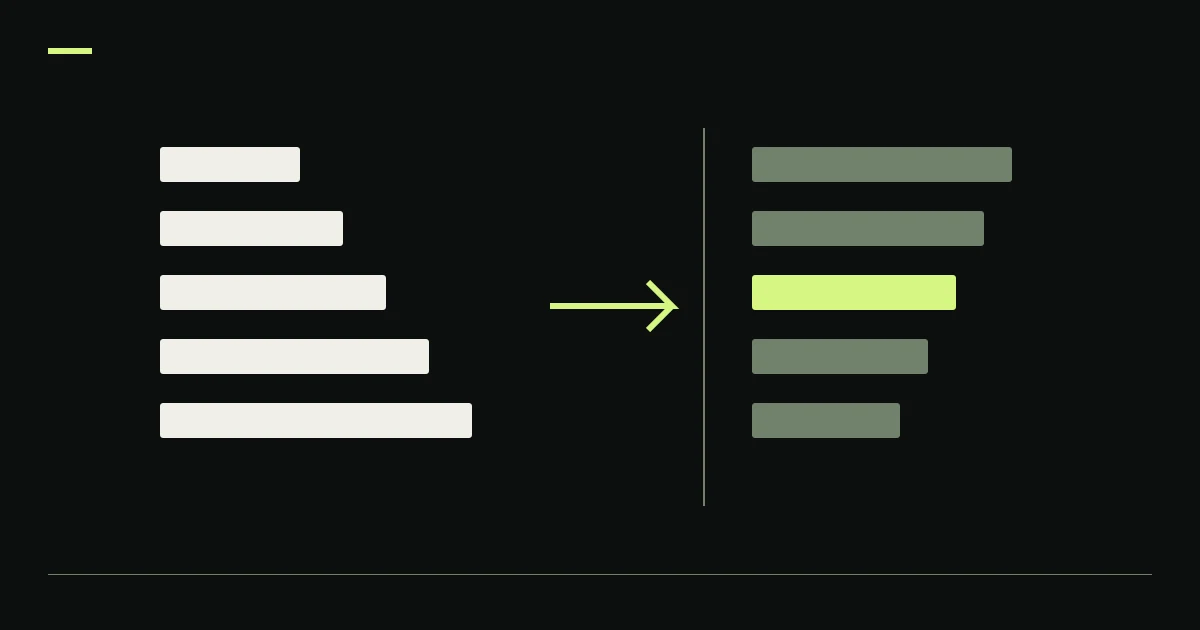
A crypto stop-market order activates a market instruction when its trigger condition is met; a stop-limit activates a limit instruction. The trigger decides when the next instruction becomes eligible. It does not guarantee an execution at the trigger price. A market instruction accepts execution-price uncertainty, while a limit instruction can leave the position open if no acceptable opposing orders are available.
The difference becomes easiest to see when price skips the intended exit level. This AI-assisted article uses an original hypothetical gap scenario and official venue documentation. It is educational, not a recommendation for a particular stop distance or a guarantee that losses can be capped.
Write the stop as two separate sentences
Start with the condition: “When the specified reference price reaches this threshold, activate the instruction.” Then write the instruction: “Sell this quantity at available prices,” or “sell this quantity at this limit or higher.”
For a buy stop, the price boundary runs in the other direction: a buy limit cannot pay above its ceiling. Direction matters. A copied sell example can become an incorrect buy instruction if the inequalities are not reversed.
Binance Spot distinguishes STOP_LOSS, which activates a market order, from STOP_LOSS_LIMIT, which activates a limit order. Its glossary makes the trigger and resulting order type separate concepts. Binance Spot: API glossary.
The same principle is useful beyond those exact names, but names and availability vary. Read the rules for the actual product rather than assuming a spot symbol and a leveraged perpetual contract share identical stop semantics. The market versus limit order guide explains the underlying price constraints without the conditional layer.
What happens when the book jumps below a sell limit?
Assume a fictional ABC/USDT spot holding of 100 ABC acquired at 10.00 USDT each. Ignore fees. The operator sets a stop trigger at 9.50, intending an exit after a decline. Compare a stop-market instruction with a stop-limit instruction whose sell limit is 9.45.
At the moment the condition activates, suppose the available bids are 40 ABC at 9.44 and 60 ABC at 9.40. Assume that book stays unchanged, both instructions are otherwise valid and the market instruction can execute against all those bids without another product restriction. These are constructed assumptions, not a real historical gap.
| Instruction activated | Modeled outcome in this book | Gross sale proceeds |
|---|---|---|
| Market sell for 100 ABC | 40 ABC at 9.44 and 60 at 9.40 | 941.60 USDT |
| Limit sell for 100 ABC at 9.45 | No displayed bid meets the 9.45 minimum | 0 USDT; holding remains |
The market calculation is (40 × 9.44) + (60 × 9.40) = 941.60 USDT, an average of 9.416 USDT/ABC. Compared with the 1,000 USDT gross acquisition cost, the modeled loss is 58.40 USDT before fees.
An exit exactly at the 9.50 trigger would instead produce 950 USDT and a 50 USDT loss before fees. The extra 8.40 USDT illustrates why multiplying quantity by trigger distance does not guarantee the realized loss.
The stop-limit respected its minimum sale price. That does not make it a completed protective exit. With the holding still open, future losses or gains depend on later market activity and any subsequent actions.
A later rebound is also uncertain. If, in a separate hypothetical continuation, a 30-ABC bid appears at 9.46, only 30 ABC can execute against that bid. The sale produces 283.80 USDT and leaves 70 ABC exposed if nothing else trades. The limit has not become a promise to fill the whole holding merely because one acceptable bid appeared.
A wider trigger-to-limit gap trades one risk for another
Moving the sell limit farther below the trigger allows more prices after activation. It can therefore make a fill possible in more constructed books, but it also authorizes a worse execution price. There is no universal distance that makes both price and completion certain.
A tightly spaced limit is not automatically conservative when the purpose is to exit exposure. It restricts price, while potentially retaining a large position during a fast decline. A loose limit is not automatically safe either; it may permit a much larger realized loss than a reader inferred from the trigger.
Model this explicitly with the quantity, acceptable prices and the amount that remains if each level is unavailable. The slippage and order-book-depth worksheet provides a way to inspect those quantities without pretending a frozen book predicts the next market state.
Avoid treating a rule such as one percent below entry as complete risk management. Its meaning depends on position size, entry costs, product leverage, trigger source, execution conditions and account resources. The stop distance is only one input.
Which price activates the order?
A stop specification needs a reference-price source. Last traded price, mark price and index price describe different observations. A candle built from trades does not establish where a mark-based trigger stood at the same instant.
Bybit documents reference-price choices for conditional orders, including last traded, mark and index prices where supported. The applicable selection depends on the product and instruction. Bybit: types of orders.
For leveraged positions, this choice must be read alongside the liquidation rules. Bybit explains that mark-price liquidation can occur before a last-traded-price stop reaches its trigger. A stop visible on a trade-price chart therefore cannot prove liquidation was impossible. Bybit: order execution and liquidation FAQ.
This is not a universal instruction to choose one trigger basis. Compare what each reference measures, the actual liquidation mechanism and the possibility of execution delay after activation. The mark price and liquidation guide works through that distinction separately.
Accepted, triggered, submitted and filled are different evidence
A saved stop can establish that an instruction was accepted under conditions at placement. Triggering establishes that its activation condition was met. A submitted child order establishes another attempt. A fill establishes execution of a quantity. None of these observations should stand in for all the others.
For example, a conditional instruction can encounter an account constraint at activation. Bybit's order API documents cancellation of conditional orders when margin is insufficient at trigger time. An earlier acceptance is not proof that the later order will pass every check. Bybit API: place order.
A useful record keeps the original conditional identity, trigger source and threshold, resulting order identity, cumulative fills, cancellation state and remaining exposure. If an acknowledgement is missing, keep that uncertainty visible rather than replacing the instruction based on a guess.
Market orders can also encounter venue price protections, unavailable liquidity, rejection or cancellation. The worksheet above deliberately assumes complete available execution so it can isolate the limit difference. It does not establish that every real stop-market order will fill completely.
This distinction matters for dashboards. A triggered badge can look reassuring while the account remains exposed. The status that resolves the operational question is the confirmed executed quantity and residual position, with any still-active instructions accounted for.
Closing a derivative position requires the right side semantics
An ordinary opposite-side order and a position-reducing instruction are not always equivalent. A quantity can become excessive if another exit trades first or if the position changes before the stop activates. The intended close can then interact with account mode and other orders in an unexpected way.
Inspect the product's reduce-only or equivalent closing semantics, supported combinations and position-side identifiers. The reduce-only guide explains why these controls address accidental position expansion rather than guaranteeing a fill or a loss cap.
A stop also needs a clear owner when several processes share an account. Another bot, an exchange-native take-profit or a manual trade may change the exposure it was sized to cover. Updating protection requires a verified sequence; simply submitting another full-size exit can create overlapping instructions.
For KLINEO workflows, read the activation and recovery guide and inspect the actual exchange records for the covered path. This article does not assert that KLINEO exposes every venue-specific trigger, amendment option or order type cited in external documentation.
Test the failure you need to understand
A useful paper exercise includes at least three constructed outcomes: activation into adequate liquidity, activation into a book beyond the limit, and activation followed by a partial fill. State the remaining position after each. A single successful replay cannot answer all three cases.
Also include an operational interruption. Who can inspect the exchange if the application disconnects? Where is the authoritative record of the stop? What observation would show that it was canceled, rejected, filled or still waiting? Do not infer ownership or active protection from a local screen alone.
Record trigger source, threshold, resulting order type, quantity, limit if any, position side, account environment and the plan for an unfilled remainder before submission. After activation, compare that record with actual executions.
The choice between stop-market and stop-limit is a choice about which uncertainty to constrain. A stop-market seeks an exit under the venue's market-order rules. A stop-limit refuses prices beyond its boundary and can leave exposure open. Both remain subject to the trading risk disclosure, including gaps, outages and losses beyond a modeled allowance.